Training and Simulation[SIM-DROP]
A simulator that teaches one thing properly: releasing a load from a drone and hitting what you aimed at.
- Skill taught
- Release judgement
- Flight software
- The real thing
- Scored
- Every drop
- Weather
- Live, random or fixed
Overview
Flying a drone is easy to practise. Delivering from one is not. The moment the load leaves the aircraft the operator has no control over it: wind, height and speed decide where it lands, and all three have to be judged before letting go. That judgement is the expensive part to learn on real hardware, costing airframes, payloads, range time, staff and good weather, and it is the part that actually misses the target.
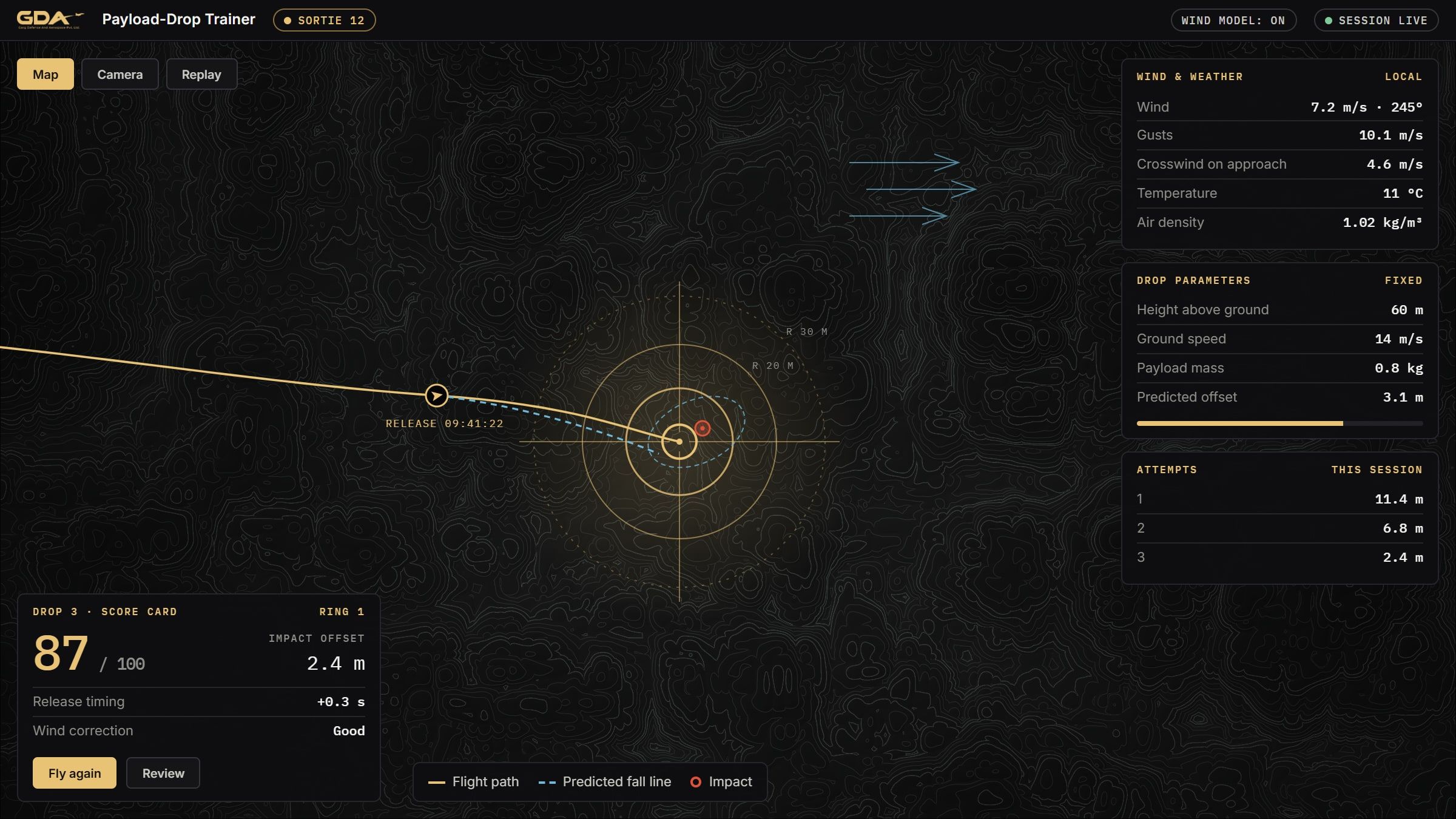
This trainer teaches exactly that skill and nothing else. The same flight software that flies a real aircraft runs underneath, so handling, safety cut-outs and failures behave as they will on the day. The falling load is modelled properly, with air resistance, wind that strengthens with height, gusts, parachute opening and landing force. Every drop is scored on how far off it landed and whether the load survived, which gives a supervisor two numbers to compare across trainees and across months.
System qualities
01 / 06
It flies on real flight software
The same autopilot code that flies actual aircraft runs underneath, so arming checks, flight modes, stick response and failsafes behave exactly as they will on the day.
02 / 06
The falling load is properly modelled
Air resistance, wind that strengthens with height, gusts, parachute opening and landing force, all from published engineering models and re-checked against reference cases.
03 / 06
Every drop is scored
Not just whether it was flown. How far off, and whether the load survived: two numbers a supervisor can compare across trainees and across months.
04 / 06
Your ground, your weather
Point it at a real location and it pulls that place's live conditions, or fix a scenario so every trainee faces an identical test.
05 / 06
Thin air behaves like thin air
Air density is derived from the site elevation, so a release at three and a half thousand metres falls faster and further than the same release near sea level, exactly as it would in the hills.
06 / 06
Runs on a laptop, offline
One installer puts the whole simulator on a training machine with no internet, no administrator rights and nothing else to install.
Specifications
Figures marked undisclosed or on request are released against a stated requirement.
Training
- Skill
- Payload release judgement
- Scoring
- Miss distance, impact speed and energy, peak load, score
- Repeatability
- Fixed scenarios for identical tests
- Trainees per instructor
- On request
- Scenario replay
- Every drop can be replayed for debrief
Simulation
- Flight software
- Production autopilot code
- Ballistics
- Drag, wind shear, gusts, parachute, impact
- Air density
- Derived from site elevation
- Hardware in the loop
- The operator flies the real transmitter and the real release switch
Environment
- Sites
- Any real location, including high-altitude sectors
- Weather
- Live forecast, generated, or operator entered
Hardware
- Controls
- Standard radio control transmitter over USB
- Machine
- Windows laptop or desktop
Deployment
- Installer
- Single file, offline, no administrator rights
Documentation
- Training and Simulation overviewAvailable on request
Applications
Works with
These are built to operate together, on one network and one picture.
Hit what you aimed at.